Unlock the White House Watch newsletter for free
Your guide to what Trump’s second term means for Washington, business and the world
The far-right Alternative for Germany is distancing itself from Donald Trump as the war in Iran proves deeply unpopular and dims hopes of an economic revival in Europe’s most populous nation.
The party last week asked its MPs building ties with the president’s Maga movement to scale back visits to the US.
“Even before the war it was sub-optimal,” a senior party official told the FT. “The AfD wants to keep contact more targeted and will no longer send large groups.”
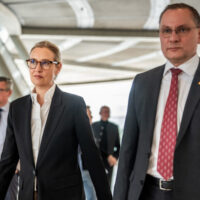
Despite efforts to court Maga and other figures close to Trump, party co-leaders Alice Weidel and Tino Chrupalla last month swiftly condemned the US decision to bomb Iran. Weidel, seen as the more pro-American voice in the party leadership, accused Washington of acting without a plan and decried the conflict as “a catastrophe”.
Jacob Ross, a research fellow at Berlin-based think-tank the German Council on Foreign Relations, said the AfD’s stance had “started to shift” since the start of this year when Trump threatened to take over Greenland.
“The intervention in Iran, and the recession it might bring to Europe, has been a tipping point,” Ross said. “Voices within the AfD that always saw the US as a bad ally have regained the upper hand.”
Many in the AfD, which is neck-and-neck with chancellor Friedrich Merz’s Christian Democrats in opinion polls, cheered the re-election of Trump. A delegation of party officials travelled to Washington for his inauguration at the start of last year.
The Maga movement reciprocated by offering unprecedented support to the AfD in the lead-up to national parliamentary elections that took place in February 2025, with prominent figures including Elon Musk and vice-president JD Vance backing the party publicly.
In the months after the vote, when the AfD came second with a record 21 per cent, the party continued to cultivate ties with Trump administration officials and the broader Maga movement.
The about-turn comes as the AfD gears up for high-stakes regional elections in two eastern states that were once part of the communist German Democratic Republic — where anti-American sentiment remains widespread.
The party is gunning for a historic first-place finish in the votes in Saxony-Anhalt and Mecklenburg-Vorpommern in September.
“I hear from most voters — although there are certainly exceptions — that they don’t like this war,” said Christina Baum, an AfD lawmaker who represents Saxony-Anhalt. “They were very positive about President Trump at first. He made this very positive promise that he wouldn’t start any more wars.”
But now, she said, voters were anxious about the impact of soaring energy prices at a time when Germany had finally been showing signs of recovery after years of stagnation. They also worried that Berlin would get dragged into the conflict. “President Trump had already called on the EU to get involved. That’s why people are afraid.”
Chrupalla used a speech in his eastern German home state of Saxony last weekend to call for the withdrawal of the roughly 38,000 US troops stationed on German soil. Though a longstanding party policy, the timing of his remarks “made particular sense”, according to Manès Weisskircher, a political scientist at Dresden University of Technology, given the conflict in Iran and “a clear majority of Germans sceptical of the war”.
A poll at the start of March by ARD-DeutschlandTrend found 58 per cent of Germans considered the US and Israel attack on Iran unjustified.
The AfD’s shift has not been without dissenting voices. Lawmaker Maximilian Krah has described Germany’s alliance with the US as “the foundation and framework of our security architecture”. Writing on X this week, he said: “A break with Trump would be harmful to the AfD in all sorts of ways. It must not be allowed to happen.”

Others, such as the party’s foreign policy spokesperson Markus Frohnmaier, have attempted to find a middle ground. Frohnmaier, one of the key figures in building ties with Maga, has praised the “surgical precision and a clear focus” of US strikes on Iran while also calling for de-escalation.
Frohnmaier last week hosted Stefano Forte, head of the New York Young Republican Club, at an event in the Bundestag. AfD members of parliament repeatedly clapped and cheered at references to Trump.
Stefan Möller, MP from the eastern state of Thuringia, said there were “two hearts in our chest”.
He said. “On the one hand, we know that Donald Trump is pursuing a political approach that is in line with ours on many issues and which also acts as a kind of protective force against attacks on the AfD as an opposition party. We are extremely grateful for that.”
“On the other hand, he is taking this very aggressive geostrategic course in foreign policy, which is not in line with our ideas.”
#Germanys #farright #AfD #distances #Donald #Trump #Iran #war